Suspension-enclosing Projection Stereolithography (SEPS) Process [Click for detail]
Related [Paper](ACS Applied Materials & Interfaces, Impact Factor 9.229)
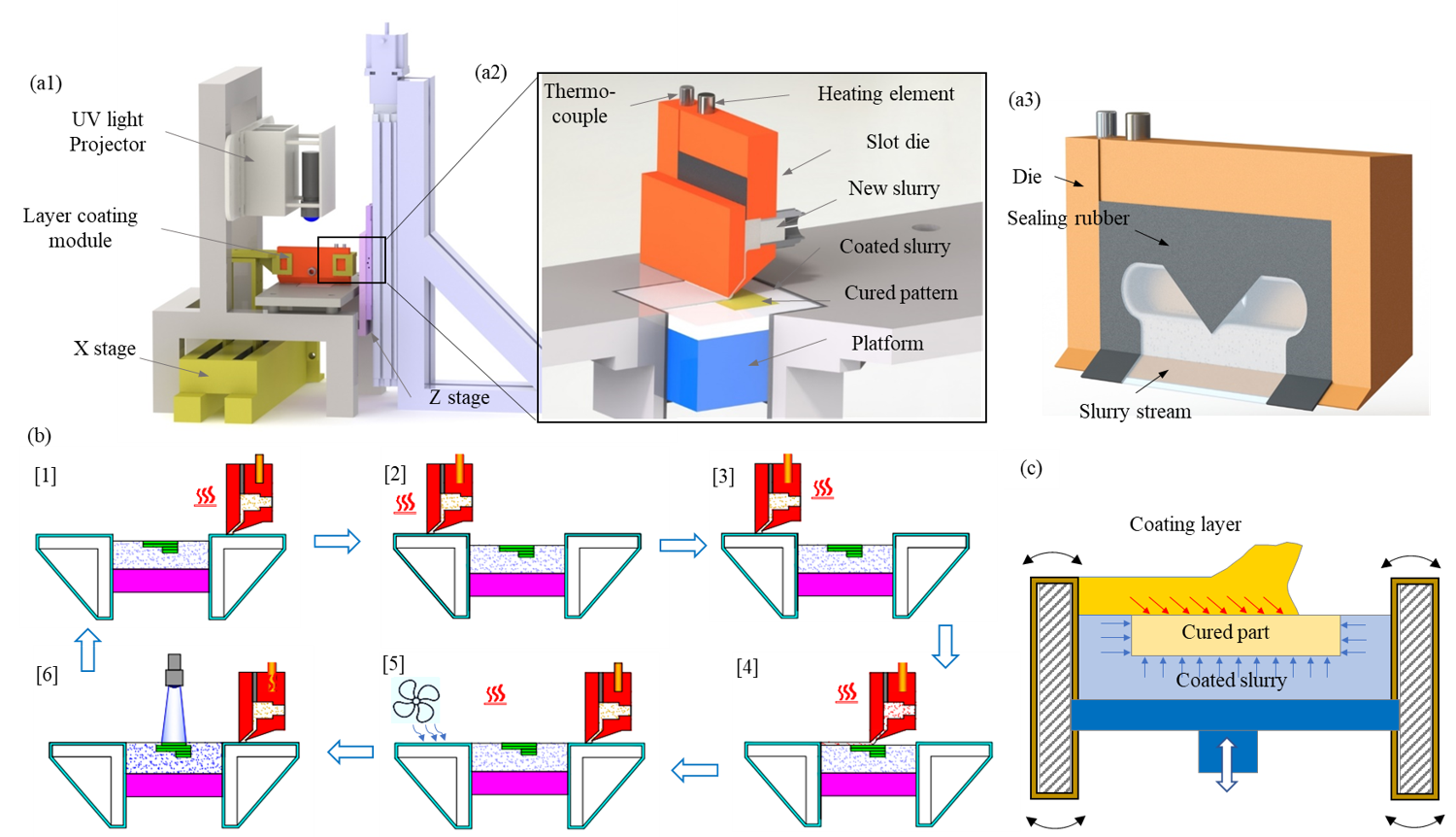
- System design of SEPS process: The fabrication system consists of a customized light engine, a temperature-controlled layerrecoating module, a cooling building platform sliding in an enclosing chamber, and X/Z stages. The light engine projects digital images with a wavelength of 405 nm via a digital micromirror device (DMD). The layer-recoating module is a customized slot die with an inclined lip and is used to recoat a thin layer of an elasto-viscoplastic ceramic suspension on top of previous layers. The temperature of the layer-recoating module is controlled through a heating element and a thermocouple. Compared to conventional slot die coating, this modified recoating method can achieve layer recoating of high-viscosity materials at a controlled shear force. The side walls of the enclosing chamber are each wrapped by a flexible belt moving with the building platform. A low temperature (e.g., 0−20 °C) is maintained in previously deposited ceramic suspensions through a cooling fan and a semiconductor chilling plate mounted under the building platform.
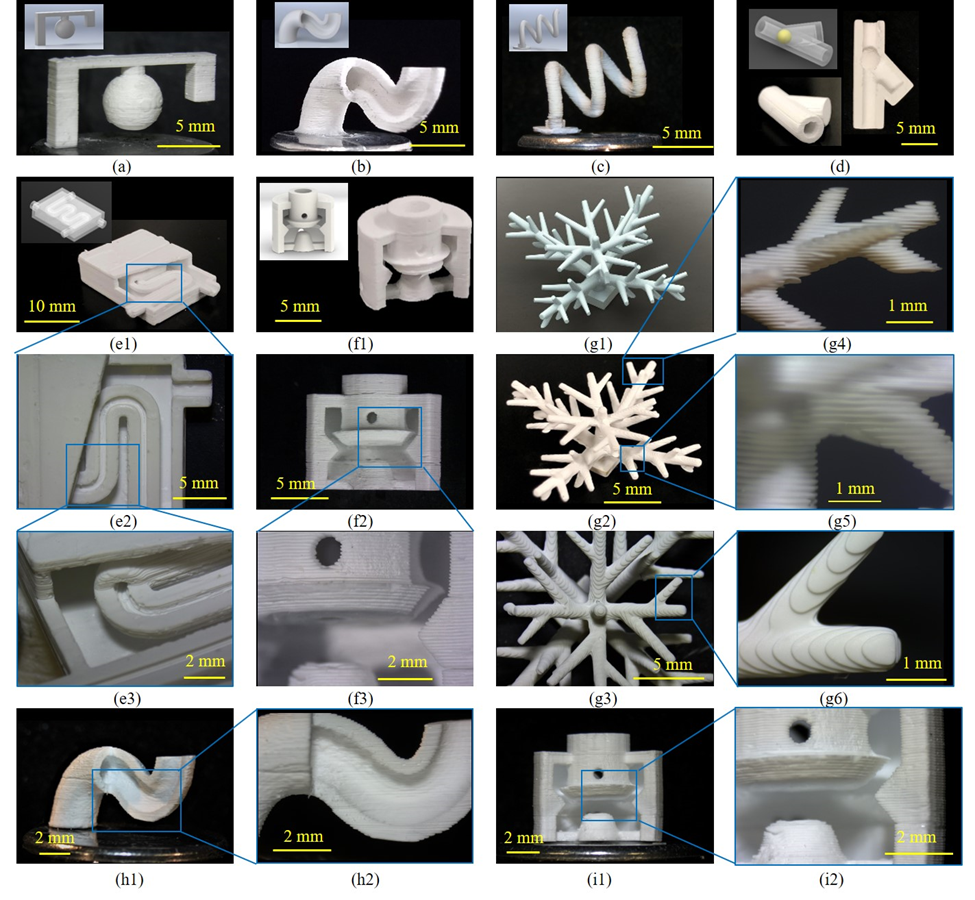
- Complex ceramic structures fabricated by SEPS process: Fabrication results via the SEPS process: (a) a structure with an overhanging ball and cube; (b) a tube with an inner overhanging chamber; (c) a spring structure printed with an upward slope angle; (d) a ball check valve with an inner chamber and a movable ball inside printed without assembly; (e) a heat exchanger with an inner chamber and overhanging hollow pipeline (e1−e3); (f) a combustion chamber with overhanging nozzles (f1−f3); (g) a CAD model of a treelike structure (g1) and the printed treelike structure and its microstructures (g2−g6); (h1,h2) the sintered overhanging tube; (i1, i2) the sintered combustion chamber.